
What Is Daily Life in Türkiye Really Like?
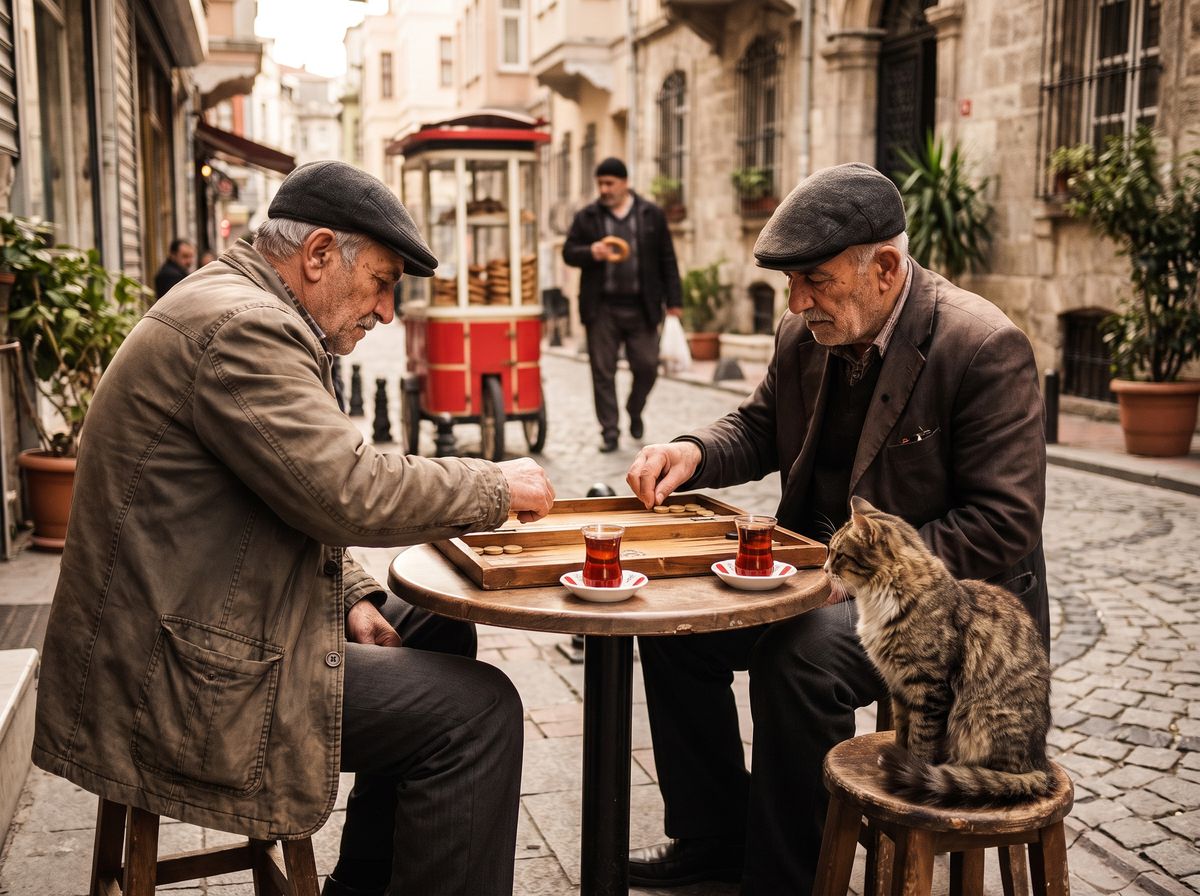
Daily life in Türkiye runs on small, shared rituals: a warm simit (sesame-crusted bread ring) bought at dawn, endless glasses of çay (black tea) over backgammon, and a slow evening stroll along the waterfront. Turks drink more tea per person than any other nation, roughly 3 kilograms each per year, and the street itself, with its vendors, cats, and conversations, is the country's real living room. For travelers, joining these rhythms costs a few euros at most and reveals more than any museum ticket.
On a 15-day route through Istanbul, Izmir, Cappadocia, and Antalya, you will see the same rituals repeat with local accents. Learn them once in Istanbul and you will recognize them everywhere.
Morning Rhythm: Simit Sellers and the First Çay
Simit sellers push their red glass carts into position around 6 a.m., and the smell of toasted sesame follows commuters onto ferries and trams. The ring-shaped bread appears in Ottoman records from at least the 1500s, and it still costs well under 1 EUR as of 2026; verify locally, since prices move quickly with inflation.
Order it sade (plain) or with a slice of white cheese, then add a glass of çay for about 0.30 to 0.80 EUR. Breakfast at a ferry railing takes 20 minutes and beats most hotel buffets. For photos and vendor etiquette, see the free Street Food gallery on turkey15days.com.
Why Do Turks Play Backgammon in Tea Gardens?
Tavla (backgammon) is social glue: the board comes out with the second glass of tea, and games are fast, loud, and full of friendly teasing. In a çay bahçesi (tea garden), a table can hold the same players for three hours while they spend less than 3 EUR.
The tea itself is homegrown, cultivated on the rainy Black Sea coast around Rize since the first half of the 20th century and served strong in tulip-shaped glasses. Most neighborhood tea gardens open from early morning until around midnight, though hours vary by season, so verify current hours. Visitors are welcome; losing gracefully usually earns you a refill.
Evening on the Kordon: The Art of the Volta
In Izmir, the day ends with a volta (a leisurely back-and-forth stroll) along the Kordon, the grassy waterfront promenade running roughly 3 kilometers between Konak and Alsancak. An hour before sunset, the lawns fill with students, families, and couples all facing the Gulf of Izmir.
The ritual is free and unhurried: buy roasted sunflower seeds or a kumru (a toasted sandwich on a soft roll, an Izmir specialty), claim a patch of grass, and watch the sky turn orange. Plan 1 to 2 hours; locals rarely rush it.
Why Are There So Many Cats in Istanbul?
Istanbul, a city of more than 15 million people, has cared for street cats since Ottoman times, when feeding animals was considered an act of charity. Estimates of the cat population run into the hundreds of thousands, and no full census has ever been completed.
Shopkeepers set out kibble and water bowls, pharmacies keep resident tabbies, and the 2016 documentary Kedi turned the phenomenon into a global story. In Kadıköy, a bronze statue installed in 2016 honors Tombili, a famously relaxed neighborhood cat. The cats look confident because the whole city, in effect, owns them.
Family Sundays: The Long Kahvaltı
Sunday mornings belong to kahvaltı (Turkish breakfast), a table crowded with cheeses, olives, honey, jams, and menemen (soft scrambled eggs with tomato and green pepper). A full spread at a café runs roughly 8 to 15 EUR per person as of 2026 and easily lasts two hours.
Afternoons move outdoors, as parks and shorelines fill with three-generation picnics gathered around a mangal (charcoal grill). If a family waves you over for tea, saying yes is the correct answer.
Football Passion, from Stadium to Tea House
Türkiye's top division, the Süper Lig, has run since 1959. Istanbul's great derbies pit clubs from the European and Asian shores against each other, and in 2000 Galatasaray became the first Turkish side to lift a major European trophy, the UEFA Cup.
Derby tickets sell out fast, so most travelers watch in a neighborhood café instead, where the whole room reacts as one body. Match nights fall between Friday and Monday during the season, roughly August to May.
European Pace, Anatolian Patience
This is the mix travelers notice most: a third-wave espresso bar sharing a wall with a bakery using a century-old oven, and a 20-minute ferry ride carrying commuters between Europe and Asia across the Bosphorus. The continent changes; the tea glass does not.
Slow down to the local tempo and the country opens up. The simit seller, the tavla players, and the cat asleep on the ferry seat are not background scenery; they are the itinerary.