
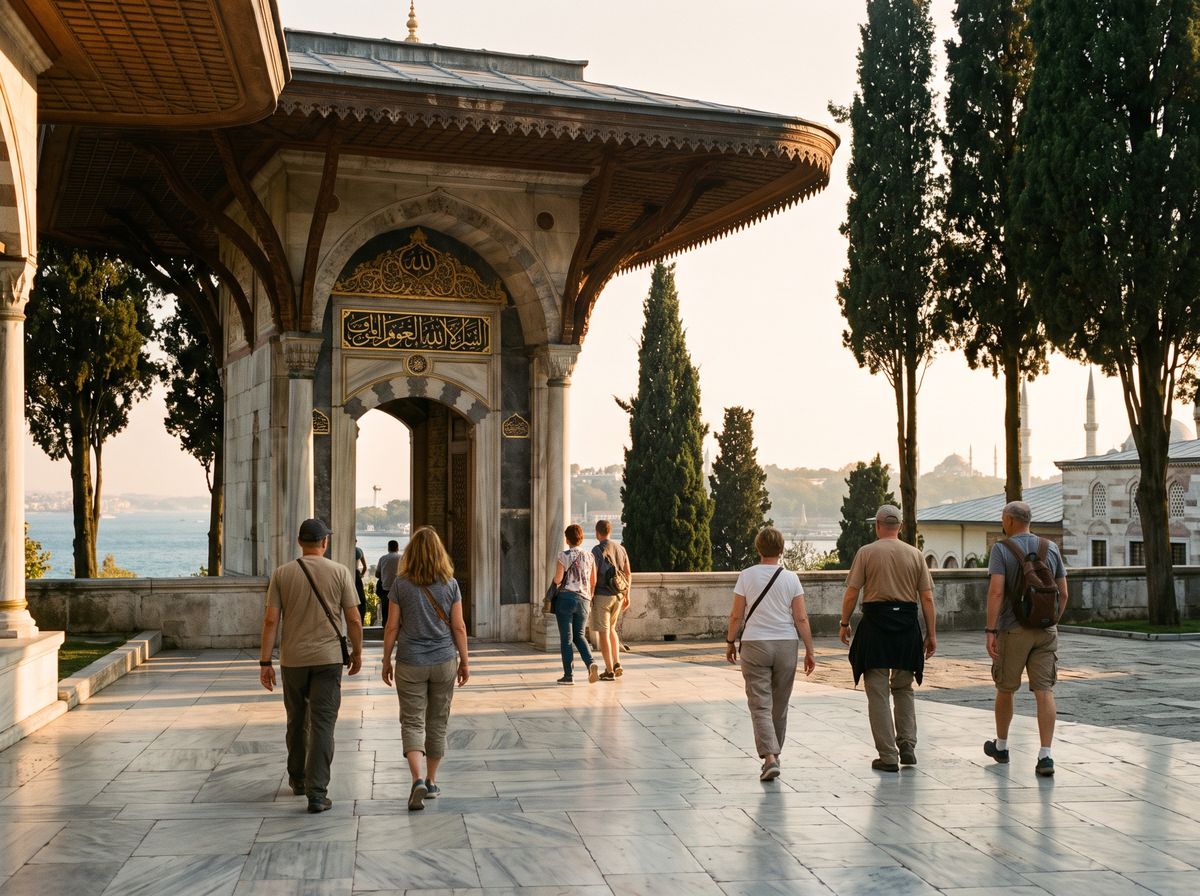
Why Topkapi Palace Is Istanbul's Essential Ottoman Landmark
Topkapı Sarayı (Topkapi Palace) was the primary residence and administrative heart of the Ottoman Empire for nearly 400 years, from the 1460s until 1856. Spread across four courtyards on a promontory above the Bosphorus, it holds the famous Harem quarters, the Sacred Relics of Islam, the imperial Treasury, and kitchens that once fed 4,000 people a day. The palace is closed on Tuesdays, and most visitors need 2.5 to 3.5 hours to see it properly.
Construction began in 1459, six years after the Ottoman conquest of Constantinople, and roughly 30 sultans governed a three-continent empire from these grounds. The complex became a museum in 1924 and remains one of the most visited sites in Türkiye.
Four Courtyards, One Empire: How the Palace Is Laid Out
The First Courtyard is a park that anyone could enter in Ottoman times; it holds Aya İrini (Hagia Irene), a Byzantine church even older than Hagia Sophia. Through the twin-towered Bab-üs Selam (Gate of Salutation) lies the Second Courtyard, the empire's administrative stage, home to the Divan council chamber and the palace kitchens.
The Third Courtyard was the sultan's private world: the Audience Chamber, the Enderun palace school, the Sacred Relics, and the Treasury. The Fourth Courtyard is pure pleasure, a run of tiled pavilions and terraced gardens with sweeping views over the Bosphorus and the Golden Horn.
What Is the Real Story of the Harem?
Forget the fantasy paintings. The Harem was the sultan's family home and a tightly run institution of roughly 300 rooms, governed not by the sultan but by his mother, the Valide Sultan, often the most powerful woman in the empire. Consorts, princes, princesses, and the staff who served them all lived within its corridors.
It also functioned as an elite school where women studied music, calligraphy, etiquette, and administration, and several rose to real political influence. In the late 1500s and 1600s, a period historians call the Sultanate of Women, Harem figures helped steer imperial policy.
The Harem requires a separate ticket, and it is the best money you will spend at Topkapi: the İznik tilework (hand-painted ceramics from the Anatolian town of İznik) in the royal chambers is among the finest anywhere. Allow 45 to 60 extra minutes.
Sacred Relics and the Treasury: What Should You Not Miss?
The Kutsal Emanetler (Chamber of the Sacred Relics) has held treasures of Islam since 1517, including the Hırka-i Saadet (the Blessed Mantle attributed to the Prophet Muhammad). A live recitation of the Quran has continued in these rooms for centuries, which makes this the most moving corner of the palace; dress modestly here.
The Treasury dazzles in a different way: the 86-carat Kaşıkçı Elması (Spoonmaker's Diamond) and the emerald-studded Topkapi Dagger are the headliners. Sections occasionally close for restoration, so check what is on display when you buy your ticket.
Kitchens That Fed 4,000 People a Day
The ten domed kitchens along the Second Courtyard once employed hundreds of cooks and staff, turning out daily meals for roughly 4,000 residents, soldiers, and officials, and far more during religious festivals. Look up as you walk through: the chimney domes are engineering as much as architecture, built to vent smoke from cauldrons that simmered around the clock.
Rebuilt by the imperial architect Mimar Sinan after a fire in 1574, the kitchens now display one of the world's great collections of Chinese porcelain, upward of 10,000 pieces. Court lore held that celadon ware changed color if food was poisoned, a useful feature in a palace.
How Long Do You Need, and How Much Are Tickets?
Plan for 2.5 to 3.5 hours, and closer to four if you linger in the Harem or visit in peak summer when lines form at each pavilion. The palace is closed every Tuesday; on other days it opens at 9:00 a.m., with closing times that shift by season, so verify current hours before you go.
As of 2026, expect roughly EUR 45 to 55 for a foreign visitor ticket covering the palace, Hagia Irene, and the Harem; the Harem is a separate add-on, so confirm it is included when you buy. Arrive at opening or after 3:00 p.m. to dodge the cruise-group crowds.
Pairing Topkapi with Hagia Sophia: The Perfect History Day
Ayasofya (Hagia Sophia) stands a five-minute walk from the palace gate, which makes the two an ideal single day in Sultanahmet, Istanbul's old city core. Start at Topkapi at 9:00 a.m. sharp, break for lunch nearby, then give Hagia Sophia the calmer mid-afternoon hours.
If your energy holds, the Yerebatan Sarnıcı (Basilica Cistern) is another five minutes on foot. This is exactly how Day 2 works in the free Istanbul day-by-day itinerary on turkey15days.com, part of the full 15-day route through Istanbul, Ephesus, Cappadocia, and Antalya.