
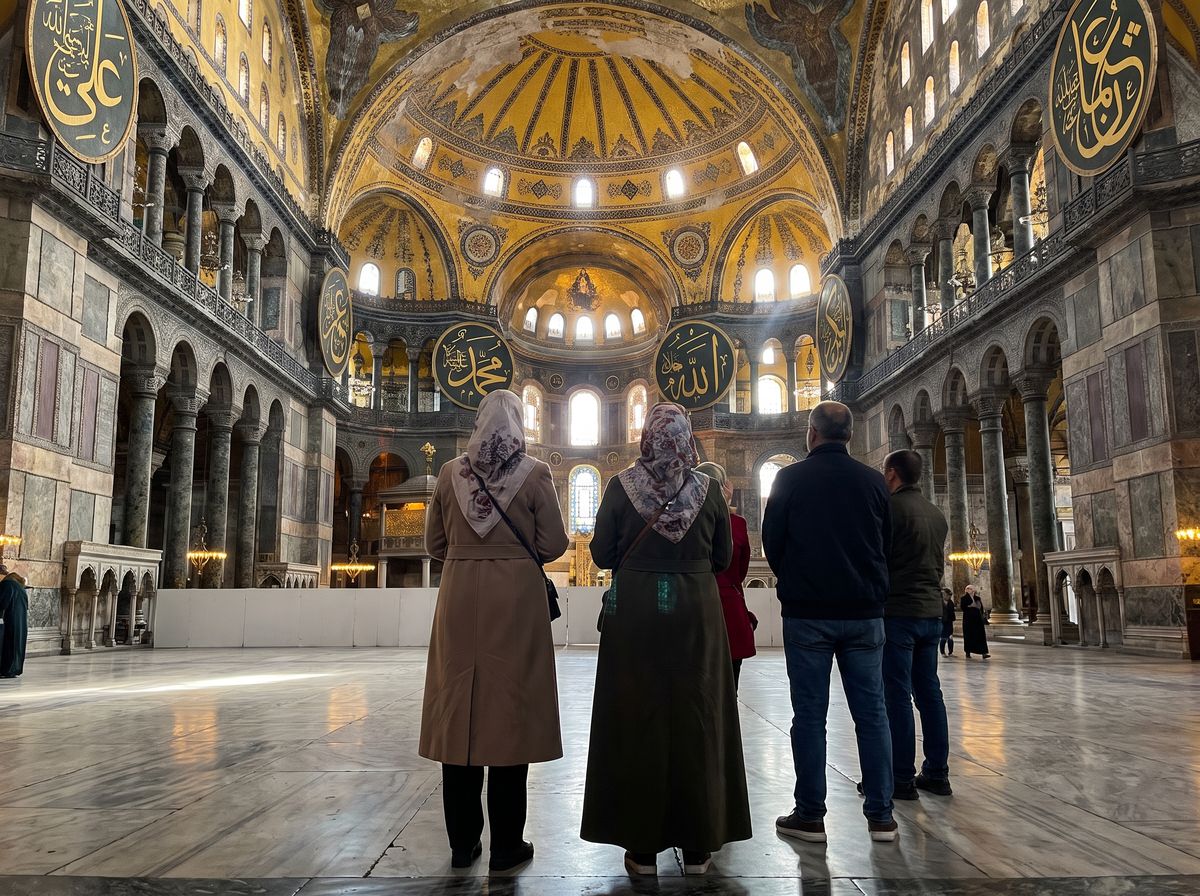
What Is Hagia Sophia and Can You Still Visit?
Hagia Sophia (Ayasofya, meaning Holy Wisdom) is a 6th century Byzantine cathedral in Istanbul that became an Ottoman mosque in 1453, a museum in 1935, and a working mosque again in July 2020. You can still visit: entry to the ground floor prayer hall is free, and non-Muslim visitors are welcome outside the five daily prayer times. Completed in 537 AD, it reigned as the largest cathedral on earth for nearly a thousand years.
That layered identity is exactly why it belongs at the top of any Istanbul itinerary. Few buildings on the planet let you stand beneath golden Christian mosaics and monumental Islamic calligraphy in a single glance.
Fifteen Centuries in One Building: A Quick Timeline
Emperor Justinian I ordered the church after riots destroyed its predecessor in 532 AD. His architects, Anthemius of Tralles and Isidore of Miletus, finished the work in under six years, and the cathedral was consecrated in 537.
After the Ottoman conquest of Constantinople in 1453, Sultan Mehmed II converted it into an imperial mosque. Minarets, a mihrab (prayer niche), and massive supporting buttresses were added over the following centuries.
The young Turkish Republic opened it as a museum in 1935, and for 85 years it welcomed visitors of every faith. In July 2020 it was reconverted to a mosque, with the first Friday prayers held on July 24, 2020.
How Did They Build That Dome in 537 AD?
The central dome spans roughly 31 to 33 meters, slightly elliptical after centuries of repairs, and its crown floats about 56 meters above the marble floor. The trick is the pendentive: four curved triangles of masonry that funnel the dome's enormous weight down into four great piers, freeing the walls below to open into arcades and windows.
A ring of 40 windows at the dome's base makes it appear to hover on light, an effect that stunned 6th century writers. The first dome partially collapsed after earthquakes in 558 AD; Isidore the Younger rebuilt it by 562, raising it about 6 meters on lighter ribs. That second dome, patched but standing, is essentially what you see today.
Mosaics and Calligraphy: Two Faiths, One Ceiling
Ottoman plaster, applied because Islamic tradition avoids figurative images in prayer spaces, accidentally preserved the Byzantine mosaics for centuries. Restorers began uncovering them in the 1930s. Look for the 9th century Virgin and Child in the apse, the imperial portrait panels, and the moving 13th century Deisis mosaic of Christ in the upper gallery.
Sharing the space are eight calligraphic roundels about 7.5 meters across, painted with the names of Allah, the Prophet Muhammad, and the early caliphs. Since 2020, figurative mosaics in the prayer area are discreetly curtained during worship, while the gallery mosaics remain visible to visitors.
How Does Visiting Work Now That It Is a Mosque Again?
Entering to pray on the ground floor is free, as it is at every mosque in Türkiye. Since January 2024, foreign sightseers follow a separate route through the upper gallery for a fee of about 25 EUR as of 2026; verify the current price before you go.
Tourist visits run roughly 9:00 a.m. to 7:30 p.m. daily as of 2026, with short pauses around the five daily prayers; verify current hours in season. The big one to plan around: every Friday the building closes to sightseers from about 12:30 to 14:30 for cuma namazı (Friday congregational prayer).
Dress Code: What to Wear Inside
Everyone must cover shoulders and knees, so skip shorts and tank tops. Women need a headscarf, and simple scarves are usually available at the entrance if you forget yours.
Shoes come off before you step onto the carpet, so slip-ons save time. Keep voices low, never walk directly in front of someone praying, and avoid photographing worshippers up close.
Practical Tips: Timing, Location, and What to Pair It With
Hagia Sophia sits in Sultanahmet, about 300 meters from the T1 tram stop and directly across the square from Sultan Ahmet Camii (the Blue Mosque). Topkapı Sarayı (Topkapı Palace) is a five minute walk away, and Yerebatan Sarnıcı (the Basilica Cistern) is roughly 200 meters down the road.
Plan 45 to 90 minutes inside. Arrive right at opening or after 5:00 p.m. to dodge the longest lines, and never aim for Friday midday. Summer queues can stretch past 45 minutes, so shoulder season mornings in April, May, October, and November are the sweet spot.
If you are building a longer route through Türkiye, Hagia Sophia anchors days 1 to 4 in Istanbul; see the free Istanbul itinerary section on turkey15days.com for how it fits alongside the Grand Bazaar and the Bosphorus.