
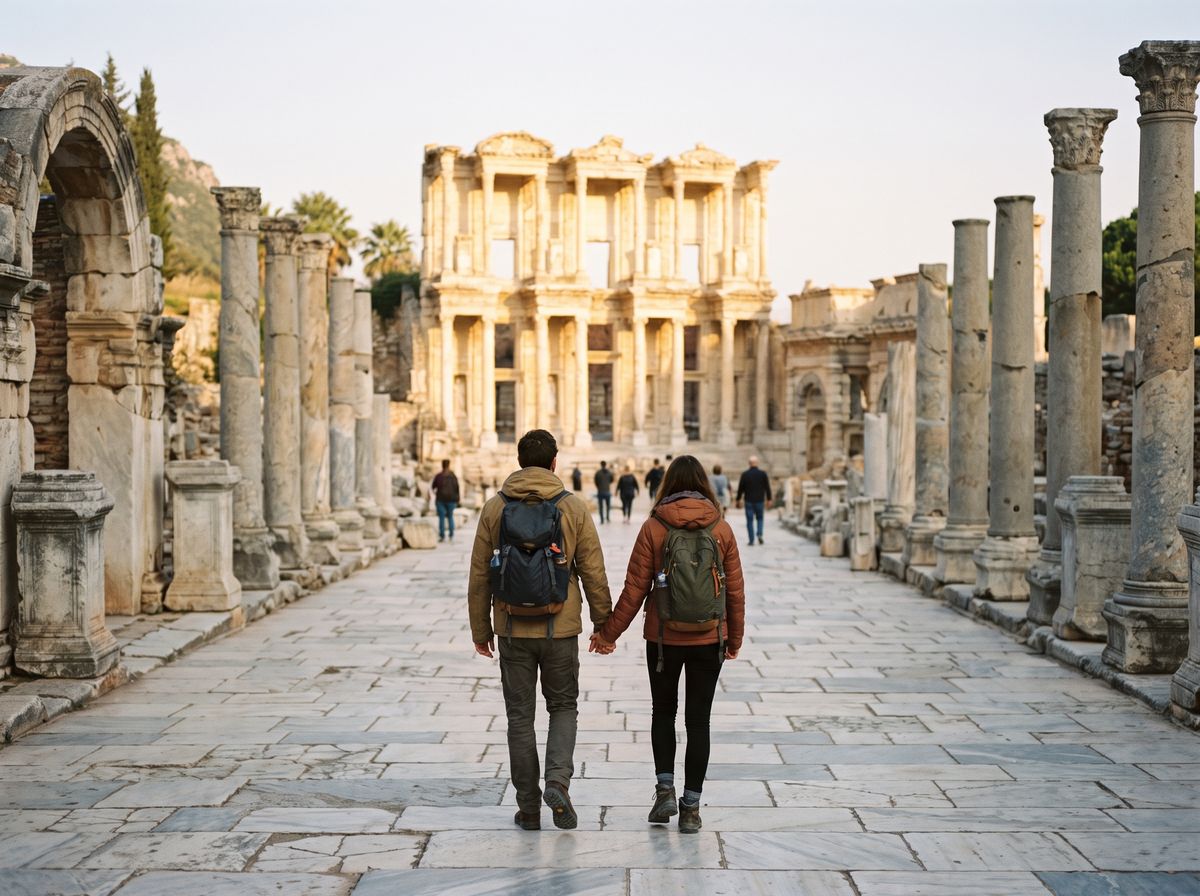
Why Ephesus Deserves a Full Morning of Your 15 Days
Ephesus (Efes in Turkish) is one of the best preserved Roman cities in the Mediterranean, and you can walk its marble streets in about three hours. The site opens at 08:00 and closes at 20:00 in high season, and arriving right at opening means you see the Library of Celsus before cruise groups from Kuşadası flood in around 10:00. As of 2026, expect roughly EUR 40 for the main site and about EUR 15 extra for the Terrace Houses; verify current prices before you go.
The ruins sit 3 kilometers from the town of Selçuk and about 80 kilometers south of Izmir, which makes Ephesus the natural anchor of the Aegean leg of a 15-day Türkiye route. At its second-century peak the city held an estimated 200,000 people, complete with a grand library, public latrines, heated baths, and a theatre for some 25,000 spectators.
What Time Should You Arrive at Ephesus to Beat the Crowds?
Be at the gate at 08:00 sharp. Cruise passengers from Kuşadası, just 18 kilometers away, typically fill the site between 10:00 and 15:00, and midsummer temperatures regularly pass 33 C with almost no shade anywhere along the route.
Summer hours run from 08:00 to 20:00, roughly April through October, with shorter winter hours; verify current times before your visit. There are two entrances: start at the upper gate so you walk gently downhill through the whole city.
Bring a hat, sunscreen, and at least one liter of water per person. The marble paving radiates heat by late morning, which is one more argument for an early start.
Curetes Street: Where Roman Daily Life Left Its Marks
Kuretler Caddesi (Curetes Street) was the city's main artery, and everyday life is still legible in the stone. Look for ruts worn by cart wheels, a game board scratched into the marble, and carved signs pointing the way to shops.
The public latrines are a favorite stop: citizens sat side by side on marble benches over channels of running water, treating the toilet as a social club. Nearby, the Temple of Hadrian, built around AD 118, and the Scholastica Baths show how much of Roman life happened in public.
The street ends at the Library of Celsus, completed around AD 135 as both a library holding some 12,000 scrolls and a mausoleum; the founder's sarcophagus still lies beneath the floor. Its two-story facade rises about 16 meters, and at 08:15 you can often photograph it with nobody in the frame.
Are the Terrace Houses Worth the Separate Ticket?
Yes, for most travelers. The Terrace Houses (Yamaç Evler) are a roofed complex of homes where wealthy Ephesians lived from the 1st to the 3rd century AD, and the separate ticket, about EUR 15 as of 2026, is the best money you will spend on site.
Glass walkways carry you over dining rooms paneled in marble, floors laid with intricate mosaics, and walls still bright with frescoes of birds, muses, and garden scenes. These houses had underfloor heating and running water, comforts much of Europe would not see again for well over a thousand years.
Allow about 45 minutes. Crowds thin dramatically here because many tour groups skip the extra fee, so it doubles as a shaded, quiet break at midday.
The Great Theatre: 25,000 Seats and One Famous Riot
The Great Theatre, carved into the slope of Panayır Dağı (Mount Pion), held roughly 24,000 to 25,000 spectators, making it the largest theatre of ancient Anatolia. Climb partway up the seating for the view down Harbor Street, the colonnaded avenue that once ran to the sea; silt has since pushed the coastline several kilometers west.
This is also where the Book of Acts places the silversmiths' riot against the apostle Paul, when craftsmen who sold silver shrines of Artemis feared for their trade. Picture a chanting crowd packing these stone tiers for two hours, and Roman daily life suddenly feels very close.
What Is Left of the Temple of Artemis Today?
One lone column, often topped by a stork's nest, standing in a marshy field on the edge of Selçuk. It is a humbling ten-minute stop: this was the Artemis Tapınağı (Temple of Artemis), one of the Seven Wonders of the Ancient World, measuring about 115 by 55 meters with 127 columns.
The temple burned in 356 BC and was rebuilt even grander before its final destruction. Entry is free and open access; several of its surviving treasures, including two famous statues of Artemis, are displayed in the Ephesus Museum in Selçuk.
The House of the Virgin Mary and How to Plan Your Day
Meryemana Evi (House of the Virgin Mary) sits on Bülbül Dağı (Nightingale Mountain), about 7 kilometers uphill from the upper gate. Many Catholics believe Mary spent her final years at this small stone chapel, and three modern popes have made pilgrimages here. Entry costs about EUR 15 as of 2026, and you will need a taxi or tour, since no public minibus climbs the hill.
A comfortable rhythm: Ephesus at 08:00, Terrace Houses mid-morning, the House of the Virgin Mary before noon, then lunch in Selçuk and the Temple of Artemis in the softer late-afternoon light. For how this day fits the wider Aegean leg of your route, see the free day-by-day itinerary section on turkey15days.com.