
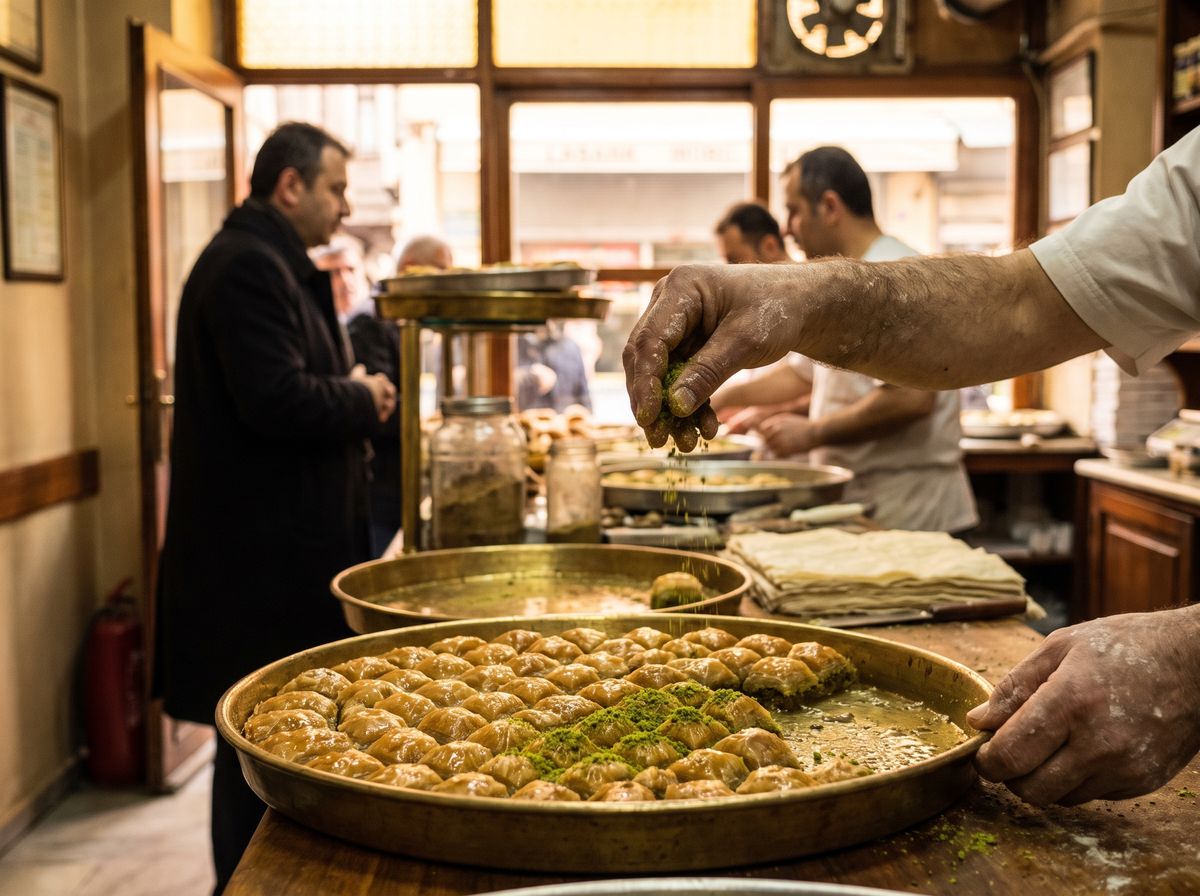
Baklava, the National Obsession
Baklava is Türkiye's signature dessert: roughly 40 paper-thin layers of filo pastry brushed with clarified butter, packed with ground Gaziantep pistachios, and soaked in hot sugar syrup. The finest baklava comes from Gaziantep in the southeast, and in Istanbul the historic place to eat it is the Karaköy district. Expect to pay about 15 to 25 EUR per kilo at a serious shop as of 2026.
The Turkish sweet tooth is not an afterthought; it is a social institution. Trays of baklava travel to weddings, religious holidays, and job promotions, and a proper Turkish dinner ends with dessert, strong tea, and unhurried conversation.
What Makes Gaziantep Baklava the Gold Standard?
In Gaziantep, master bakers roll each sheet of filo so thin you can read a newspaper through it, then stack around 40 layers per tray. The nuts are Antep fıstığı (Gaziantep pistachios), harvested early so the kernels keep a vivid emerald green color and an intense, almost floral flavor.
The city's reputation is official: Antep Baklavası became the first Turkish product to earn the European Union's protected geographical indication, registered in 2013. Gaziantep sits about 1,100 km southeast of Istanbul, roughly a 90 minute flight, but its baklava masters staff the best shops nationwide.
Where Should You Eat Baklava in Istanbul?
Head to Karaköy, the waterfront quarter at the northern end of the Galata Bridge, about 10 minutes on foot from Eminönü. Baklava families from the southeast settled here generations ago, and the neighborhood's landmark baklava house has been serving since 1949.
Order fıstıklı (pistachio) baklava as your baseline, then branch out: cevizli (walnut) is the older Anatolian style, and soğuk baklava (cold baklava with milk-infused syrup and cocoa) is the modern favorite. A four piece portion with tea runs about 3 to 5 EUR as of 2026; most shops open around 8 a.m. and close late, but verify current hours.
How Can You Tell If Baklava Is Fresh?
Look for the sheen first. Fresh baklava has a glossy, lacquered surface where the syrup has been fully absorbed; a dull, wet, or collapsed top means the tray has been sitting too long or was drowned in syrup to hide staleness.
Then listen for the crunch. Your fork should break through with an audible crackle, and the filo sheets should stay distinct rather than compressing into a gummy mass. Good baklava smells of butter, not old oil, and it is best eaten within 24 to 48 hours of baking. Never refrigerate it; the butter hardens and the layers lose their snap.
Künefe: The Dessert You Order Before Your Main Course
Künefe (a hot dessert of shredded kadayıf pastry filled with melting cheese) comes from Hatay in the far south and is cooked to order in a shallow copper pan, which takes 10 to 15 minutes. Smart diners order it at the start of the meal so it lands on the table at the right moment.
Eat it immediately: the mild, unsalted cheese inside stretches into long ribbons only while hot, then sets within minutes. A portion topped with clotted cream or ground pistachio costs about 2 to 4 EUR in Antalya's old town as of 2026.
Turkish Delight: A Sweet With 250 Years of History
Lokum (Turkish delight) is a soft confection of starch and sugar, perfumed with rosewater, mastic, or pomegranate and often studded with double roasted pistachios. Istanbul's most storied lokum shop was founded in 1777 by an Ottoman court confectioner, and the original family business still operates near the Spice Bazaar.
European travelers carried the sweet home in the 1800s, coining the English name Turkish delight. Buy it freshly cut from large blocks rather than prepackaged; expect roughly 8 to 15 EUR per kilo as of 2026, with pistachio-heavy varieties at the top of that range.
Lokma and Dondurma: Sweets You Eat Standing Up
Lokma (fried dough balls soaked in syrup) doubles as a street ritual: families rent a lokma cart and hand out free portions to passersby in memory of a loved one, a tradition you will see most often in Izmir. A paid serving from a stand costs about 1 to 1.5 EUR.
Dondurma (Turkish stretchy ice cream) gets its chewy, elastic texture from salep, a flour ground from wild orchid tubers, plus mastic resin. The classic version comes from Kahramanmaraş and is dense enough to eat with a knife and fork; a cone from a costumed street vendor runs about 1.5 to 2 EUR.
You will meet every one of these sweets along the 15 day route, from Karaköy to Antalya's harbor; see the free Street Food gallery on turkey15days.com for photos of what each should look like before you order.